
Why gummy innovators are ditching starch in favor of cleaner, faster production
Share
FOR IMMEDIATE RELEASE
by: Keith Graham, Business Development Manager, Coperion Food, Health & Nutrition
As the market for functional and premium confectionery gummies continues to expand, manufacturers are reassessing the production technologies that underpin their products. While the traditional starch mogul process remains dominant in high- volume confectionery, a growing number of nutraceutical and premium confectionery producers are adopting starch-free depositing systems.
The shift is being driven by four key factors: smaller-scale suitability, process efficiency, improved hygiene, and sustainability. Hygiene is emerging as the most decisive advantage in functional gummies while high efficiency is the main driver in small scale specialist confectionery.
Designed for a different production scale
Functional and premium confectionery gummies operate in a fundamentally different production environment than mass-market confectionery. Volumes are typically lower and formulations more complex. In this context, the starch mogul’s large footprint and multi-stage processing can be a poor fit. By contrast, starch-free systems offer a simplified process, reduced equipment requirements, and a smaller physical footprint, making them well suited to niche and specialist producers.
This scalability is particularly appealing for manufacturers looking to trial new formulations or address emerging health trends without committing to major capital investment.
Hygiene as a competitive advantage
Hygiene is arguably the most compelling reason behind the shift. Hygiene standards are particularly stringent in nutraceutical manufacturing, where products often make implicit or explicit health claims. Traditional starch moguls, which rely on reusable starch beds, introduce complexity in cleaning and contamination control.
Starch-free systems, by comparison, use solid moulds that do not absorb moisture and are easier to clean and sanitise. This significantly reduces the risk of cross-contamination and helps manufacturers meet higher regulatory and quality expectations.
The elimination of starch handling also creates a cleaner production environment, further supporting compliance with safety standards.
Efficiency gains drive adoption
Starch-free depositing eliminates several energy-intensive stages inherent to mogul systems, including starch conditioning, drying, and recycling. Instead, syrup is deposited at its final solids level, with excess moisture removed during cooking using a thin-film process – one of the most energy-efficient methods available.
Because no additional drying is required post-depositing, production times are reduced, and throughput becomes more predictable. The process also minimises material handling and cleaning, resulting in lower labour requirements and less downtime.
Flexibility further enhances efficiency. Stackable mould systems allow manufacturers to adjust cooling and conditioning times without interrupting production. Product changeovers can be as simple as switching mould sets, in some cases without halting the depositor at all.
As an alternative to stacking, moulds may be fixed to a continuous chain circuit that runs through a cooling tunnel. Although this is a simpler system it is suitable only for manufacturing pectin gummies in a single shape.
Taken together, these factors deliver a leaner, faster, and more responsive production model – critical advantages in the fast-moving functional foods sector.
Supporting sustainability goals
Sustainability is another major driver of change. Starch-free depositing reduces both energy consumption and material waste. By eliminating starch trays, manufacturers avoid the need for continuous starch drying and recycling – an energy-heavy process in traditional systems.
Additionally, because products are deposited at final solids and do not require drying, overall energy use is significantly lower.
Plastic moulds, designed for repeated use and efficient heat transfer, further enhance the system’s environmental credentials. The result is a process that aligns more closely with industry-wide efforts to reduce carbon footprints and improve resource efficiency.
Enabling product innovation
Beyond operational improvements, starch-free technology opens the door to new product formats. Precision depositing into solid moulds enables the production of complex structures such as 3D shapes, layered gummies, and liquid-filled formats capabilities that are difficult or impossible to achieve with starch moguls.
For functional and premium confectionery gummy manufacturers, this translates into greater differentiation in an increasingly crowded market.
A structural shift in gummy manufacturing
The move toward starch-free depositing reflects a broader shift in the confectionery and nutraceutical landscape. As demand for functional and premium confectionery gummies grows, manufacturers require processes that are more agile, efficient, and aligned with modern hygiene and sustainability standards.
Coperion’s Baker Perkins technology is embracing this shift with a modular, scalable range of cookers and starch-free depositors. The ServoForm Flexi range uses stackable moulds for flexibility and starts with outputs of less than 300kg/hr for a simple manual system rising to 1,000kg/hr for fully automated.
While starch moguls will remain essential for high-volume confectionery, starch-free systems are rapidly becoming the technology of choice for applications where hygiene, flexibility and efficiency matter most.
For more information, visit
For more information, please contact:
Jennifer Prusa
jprusa@peerlessfood.com
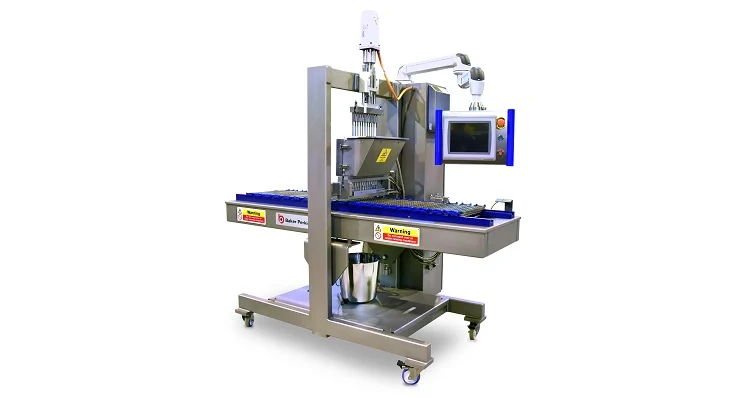
depositor sits at the heart of a smaller-scale
production line capable of producing
deposited gummies, jellies, hard candies, caramels,
toffees, and lollipops.
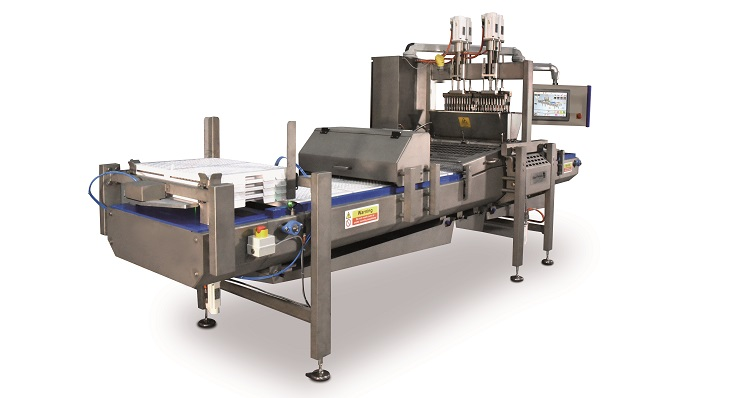
Baker Perkins uses stackable moulds for
flexibility and starts with outputs of less than
300kg/hr for a simple manual system rising
to 1,000kg/hr for fully automated.
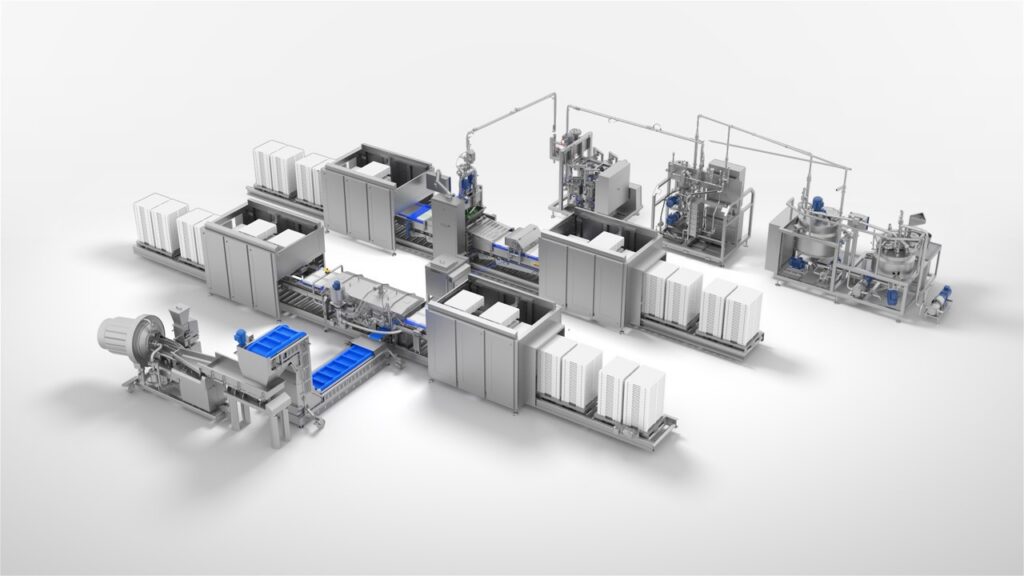
ServoForm Flexi+ automated gummy manufacturing system New
Coperion offers fully automated starch-free gummy production for higher-capacity gummy and jelly production up to 1,000 kg/hr.
About Coperion
Coperion (www.coperion.com) is a global industry and technology leader in specialized equipment for the food and health industries. Coperion develops, produces, and services plants, machinery, and components for the food, pet food, baking, pharmaceutical, and cosmetics industries. Its brands – Baker Perkins, Bakon, K-Tron, Diosna, Gabler, Kemutec, Peerless, Shaffer, Shick Esteve, Unifiller, and VMI – are experts in ingredient automation, pre-dough systems, mixing, and depositing technologies. Coperion employs more than 5,000 people in its three divisions Performance Materials, Food, Health & Nutrition, and Aftermarket Sales & Service, and in its over 50 sales and service companies worldwide. Coperion is an Operating Company of Hillenbrand, a global industrial company that provides highly-engineered, mission-critical processing equipment and solutions to customers serving a wide variety of industries around the world. www.hillenbrand.com
Stay connected
Subscribe to keep up to date with current perspectives, events, white papers and more.